The Executive Transition
She accepted a $385,000 executive offer. She had $1.2 million in her former employer's 401(k). And for the first time in years, she had to decide what should happen to the retirement money she'd spent two decades building.
Lauren's career transition is exciting. Her compensation is increasing. She's being recognized for years of leadership and expertise. But the offer comes with financial decisions that deserve more attention than simply signing the onboarding paperwork—because changing employers doesn't automatically mean moving retirement assets is the right decision.
Companion article: Questions to Ask Before Rolling Over a Retirement Account
Dr. Lauren Chen, 55
- Career
- Chief Information Officer transitioning to Chief Digital Transformation Officer at a national healthcare organization
- New annual compensation
- Approximately $385,000, including target incentives
- Former employer's 401(k)
- Approximately $1.2 million
- Other assets
- Taxable investment account, emergency savings, home equity, and existing life insurance
- Family
- Married, two adult children
- Retirement horizon
- Approximately 8–10 years
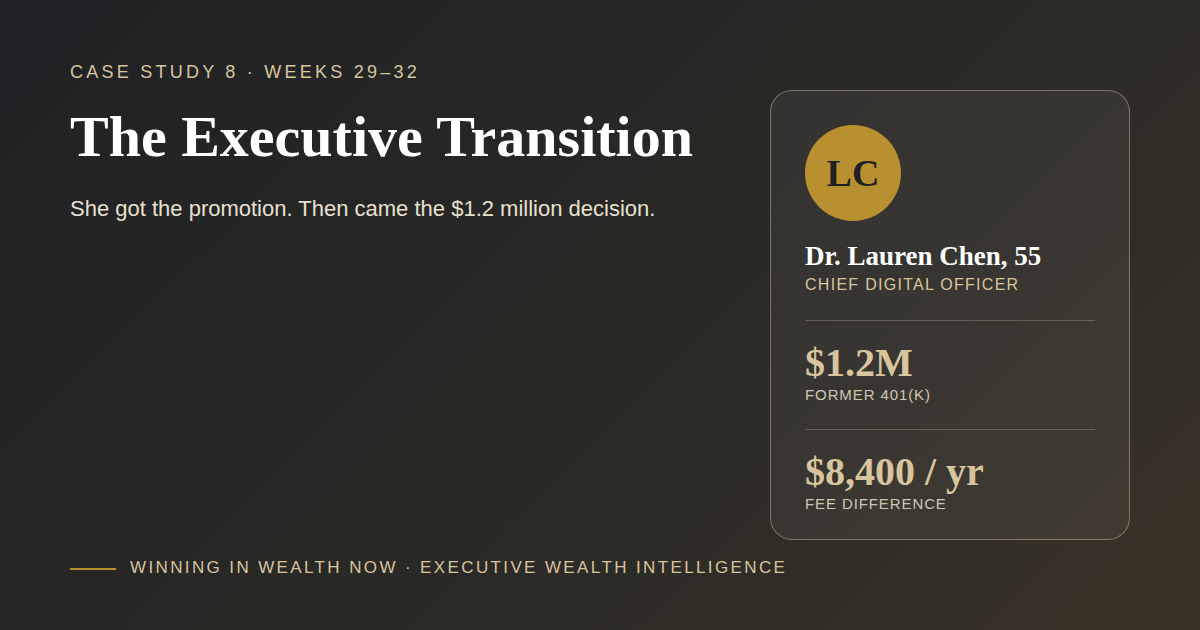
She Got the Promotion. Then Came the $1.2 Million Decision.
Lauren had just accepted a $385,000 executive offer.
But the financial decision she was least prepared for had nothing to do with her new salary.
Meet Dr. Lauren Chen.
55 years old.
A respected technology executive.
Twenty years with her former employer.
A new opportunity to lead digital transformation at a national healthcare organization.
And approximately $1.2 million in her former employer's 401(k).
Lauren was excited.
The new position represented everything she'd worked toward.
Greater influence.
A stronger compensation package.
A chance to shape an organization at a higher level.
But as she reviewed her transition paperwork, she came across a question she'd never seriously considered.
“What should I do with my old 401(k)?”
She had heard different answers.
“Roll it into an IRA.”
“Move it to your new employer's plan.”
“Leave it where it is.”
“Consider an annuity.”
Each suggestion sounded confident.
But no one had started by asking Lauren what she needed the money to accomplish.
And that bothered her.
Because she wasn't making a decision about a small account she'd forgotten existed.
She was making a decision about more than a million dollars accumulated over two decades.
So she began with a different question.
“What are my actual options, and what would I gain or give up with each one?”
Depending on the plan rules and her circumstances, Lauren could potentially:
OPTION 1: LEAVE THE MONEY IN HER FORMER EMPLOYER'S 401(K).
She might be able to retain access to its investments, fees, and plan features.
OPTION 2: MOVE THE MONEY TO HER NEW EMPLOYER'S 401(K).
If the new plan accepts incoming rollovers, she may be able to consolidate retirement assets there.
OPTION 3: ROLL ELIGIBLE MONEY INTO AN IRA.
This may provide access to a broader range of investments, but the costs, protections, and tax consequences require evaluation.
OPTION 4: TAKE A DISTRIBUTION.
But a cash distribution of pre-tax retirement money may create substantial income taxes and potentially additional tax consequences.
Lauren realized that a job change creates an opportunity to review retirement assets.
It doesn't create an obligation to move them.
And a rollover isn't automatically beneficial simply because someone recommends one.
If you're changing employers, identify:
The balance in your former employer's retirement plan.
Whether the plan permits you to leave your money there.
Whether your new employer's plan accepts rollovers.
Your available IRA options.
Any tax, fee, investment, or distribution considerations that could affect the decision.
Don't make a retirement-account decision based solely on convenience.
Lauren discovers that two retirement accounts with the same balance can have very different fees, investment options, withdrawal rules, and legal protections. We'll explore what to compare before moving a dollar.
The Retirement Account Fee She Never Thought to Question
Lauren had accumulated $1.2 million in her 401(k).
But she couldn't tell you what she was paying to maintain it.
That surprised her.
She had spent years managing large technology budgets.
She knew how to evaluate vendor contracts.
She negotiated complex financial commitments.
Yet when it came to her own retirement account, she had never closely examined the total cost.
Last week, I introduced Lauren.
A 55-year-old executive transitioning into a new role with approximately $385,000 in annual compensation.
She had approximately $1.2 million in her former employer's 401(k).
And she was deciding whether to leave it there, move it to her new employer's plan, or roll it into an IRA.
So she began comparing costs.
Let's look at a hypothetical illustration.
Suppose one retirement arrangement has total annual costs of 0.40%.
Another has total annual costs of 1.10%.
| Account cost assumption | Annual cost on $1.2M |
|---|---|
| 0.40% | $4,800 |
| 1.10% | $13,200 |
| Difference | $8,400 |
A difference of $8,400 in one year, based on the same starting balance.
That's not a forecast of future fees or investment performance.
But it demonstrates why costs deserve attention.
And Lauren discovered that the expense ratio of an investment fund isn't necessarily the only cost.
Depending on the account and services, there may also be:
Plan administration fees.
Investment management fees.
Advisory fees.
Transaction costs.
Insurance-related charges.
Or other account expenses.
But cost wasn't the only issue.
Lauren also needed to compare the investment options.
Her former employer's plan offered certain institutional investment choices.
An IRA might offer broader investment flexibility.
Her new employer's plan might have a different menu and different administrative features.
She couldn't assume that more investment choices automatically meant a better outcome.
And she couldn't assume that a lower-cost account would necessarily meet all her planning needs.
Then she learned something else.
Employer retirement plans and IRAs can have different creditor protections and distribution rules.
For example, many employer-sponsored plans have federal protections under ERISA, while IRA protections depend on the circumstances and applicable law.
Those differences could matter.
Lauren realized the question wasn't simply:
“Where can I move my money?”
It was:
“Which arrangement best supports my investment needs, costs, legal protections, and retirement timeline?”
Before rolling over a retirement account, compare:
Total account and investment costs.
Available investments.
Advisory services and fees.
Creditor protections.
Withdrawal and distribution rules.
Beneficiary options.
Administrative convenience.
Request the actual fee disclosures and plan documents.
Don't rely on a verbal statement that one option is better.
Lauren discovers that the way retirement money is transferred can create tax consequences. And because she's 55, one distribution rule deserves particular attention before she moves her 401(k).
At 55, One Retirement Rule Could Change Her Rollover Decision
Lauren was about to roll her $1.2 million 401(k) into an IRA.
Then she learned about a retirement rule she didn't know existed.
The rule didn't automatically mean she should keep the money in her former employer's plan.
But it was important enough to make her reconsider the timing.
Lauren was 55.
She had just separated from her longtime employer.
And she was reviewing her retirement options during a major career transition.
That's when she learned about what's commonly called the age-55 separation-from-service exception.
Under federal tax rules, certain distributions from a qualified employer retirement plan may avoid the additional 10% early-distribution tax if the employee separates from service during or after the calendar year in which they reach age 55.
Ordinary income taxes may still apply to taxable distributions.
And the rule doesn't apply in the same way to ordinary IRA distributions.
That distinction mattered to Lauren.
Why?
Because if she rolled her eligible 401(k) assets into an IRA, she generally couldn't rely on that same age-55 exception for withdrawals from the IRA.
She wasn't planning to retire immediately.
But she valued understanding her options.
And she didn't want to accidentally eliminate a potentially useful distribution feature without considering it.
Then she discovered another important distinction.
A direct rollover is not the same as receiving a retirement distribution personally and then attempting to redeposit it.
With a properly executed direct rollover of eligible pre-tax retirement assets to another eligible retirement account, the money generally moves without current income taxation.
But if a retirement-plan distribution is paid to the participant, mandatory federal income-tax withholding may apply.
And completing an indirect rollover can involve strict deadlines and additional requirements.
Lauren didn't want to create unnecessary tax complications.
So she decided that if a rollover was appropriate, she would first understand the direct-transfer process.
She also needed to identify whether her account contained different types of money.
Pre-tax contributions.
Roth 401(k) contributions.
Employer contributions.
And potentially other special categories.
Because different portions of a retirement account may have different rollover and tax-treatment rules.
There was no reason to assume every dollar should go to the same destination.
Before moving retirement assets, ask:
What portion of the account is pre-tax, Roth, or otherwise subject to special rules?
Am I eligible for any age-based or separation-from-service distribution exceptions?
Would a rollover change my access to those exceptions?
Can the transfer be completed as a direct rollover?
What withholding, reporting, or tax consequences could apply?
Does my account contain employer stock or other assets requiring special consideration?
If your retirement account contains employer stock, ask about net unrealized appreciation rules before making an irreversible distribution decision.
Lauren realized that a rollover wasn't simply an administrative transaction.
It was a decision that could change how her retirement money was accessed and taxed.
Lauren brings everything together. She evaluates the costs, investment options, protections, tax treatment, and retirement timeline. And she builds a decision checklist before moving a dollar.
Before She Moved $1.2 Million, She Asked These 10 Questions
Lauren didn't need someone to tell her where to move her $1.2 million.
She needed to understand what she might gain—and what she might lose—by moving it.
Four weeks ago, we met Dr. Lauren Chen.
55 years old.
A successful technology executive.
New compensation of approximately $385,000.
Approximately $1.2 million in her former employer's 401(k).
And a major career transition underway.
At first, the decision seemed simple.
Leave the money.
Move it to her new employer's plan.
Or roll it into an IRA.
But as Lauren began asking questions, she discovered that each option came with different considerations.
She learned that fees could vary substantially.
She learned that investment choices and account features weren't identical.
She learned that creditor protections and withdrawal rules could differ.
And she learned that tax consequences could depend on how the transfer was handled.
So she created her own retirement-account transition checklist.
THE 10 QUESTIONS LAUREN ASKED BEFORE A ROLLOVER
1. WHAT ARE ALL MY AVAILABLE OPTIONS?
Can I leave the money in my former employer's plan? Does my new employer's plan accept rollovers? What IRA options are available?
2. WHAT AM I PAYING TODAY?
What are the total administrative, investment, and advisory costs?
3. WHAT WOULD I PAY UNDER EACH ALTERNATIVE?
Would a different arrangement actually reduce costs or provide valuable additional services?
4. WHAT INVESTMENTS WOULD I GAIN OR LOSE?
Are there institutional funds, stable-value options, or other plan features that might not be available elsewhere?
5. WHAT LEGAL PROTECTIONS APPLY?
How would creditor protections differ between the accounts under applicable law?
6. WHAT DISTRIBUTION OPTIONS WOULD CHANGE?
Would I lose access to any potentially valuable plan-specific withdrawal features?
7. WHAT TAX RULES APPLY TO MY MONEY?
Do I have pre-tax assets, designated Roth assets, employer stock, or other special considerations?
8. HOW WOULD THE TRANSFER BE COMPLETED?
Can it be handled through a direct rollover or another appropriate trustee-to-trustee process?
9. HOW DOES THIS DECISION AFFECT MY BROADER RETIREMENT STRATEGY?
What role will these assets play in future income, liquidity, and long-term growth?
10. WHO BENEFITS FROM THE RECOMMENDATION?
Is the professional recommending a rollover receiving compensation because the money moves? And have the costs, alternatives, conflicts, and reasons for the recommendation been clearly explained?
That last question mattered.
Because Lauren wanted advice that served her interests.
Not a recommendation driven by the convenience or compensation structure of the person making it.
After completing her review, Lauren was in a stronger position to decide.
She could compare the available choices.
Understand the potential trade-offs.
And coordinate the decision with her retirement goals.
She didn't need to rush.
And she didn't need to assume that moving money was automatically progress.
Before initiating a retirement-account rollover:
Request your current plan documents and fee disclosures.
Confirm your available distribution and rollover options.
Identify the tax character of your account assets.
Compare the costs, protections, investments, and withdrawal rules.
Ask for a written explanation of why a proposed rollover is appropriate for your circumstances.
And consult qualified financial and tax professionals when necessary.
Your retirement assets deserve the same level of due diligence you bring to your professional decisions.
Lauren's journey helped us understand the decisions involved in moving retirement assets. But another important question often gets overlooked: What happens to those assets when the owner dies? Next, we follow a woman whose husband passed away while owning an annuity: What Happens to an Annuity When the Owner Dies? Because building wealth is one responsibility. Understanding how it transfers is another.
From career transition to retirement-asset clarity
“Changing employers doesn't automatically mean I should move my retirement account.”
“Fees, investment choices, and legal protections can differ between accounts.”
“Rollover decisions can affect taxes and withdrawal options.”
“I can evaluate the alternatives before moving my retirement assets.”
Retirement Account Fee Comparison
Simple fee comparison based on a constant account balance and annual percentage costs. Does not project investment returns, compounded fees, taxes, or the value of advisory services and plan features.
See where you stand. Talk to a licensed professional.
Dr. Lauren Chen is a fictional composite created for education. All figures are hypothetical illustrations, not client results, quotes, or guarantees. Educational information only; not tax, legal, insurance, or investment advice. Product availability varies by state.