The Retirement Income Reality
She built a million-dollar retirement portfolio. Now she's discovering that accumulating wealth and turning it into dependable retirement income require two very different strategies.
This is not a story about fear of retirement. It's a story about moving from accumulation to financial independence with clarity, confidence, and choice. Victoria has worked, saved, invested, and contributed to retirement accounts. She isn't financially unprepared. But as retirement approaches, she's discovering questions that were easy to postpone while she was still earning a substantial salary.
Companion article: How to Evaluate a Retirement-Income Strategy
Victoria Ellis, 57
- Career
- Senior Vice President of Corporate Strategy at a national healthcare organization
- Annual compensation
- $310,000, including bonus
- Retirement assets
- Approximately $1 million across her 401(k), IRA, and investment accounts
- Family
- Divorced, two adult children
- Retirement goal
- Step away from full-time corporate leadership at 62, with the flexibility to consult or mentor selectively
- Lifestyle
- Travel, golf, family experiences, and possibly extended periods abroad
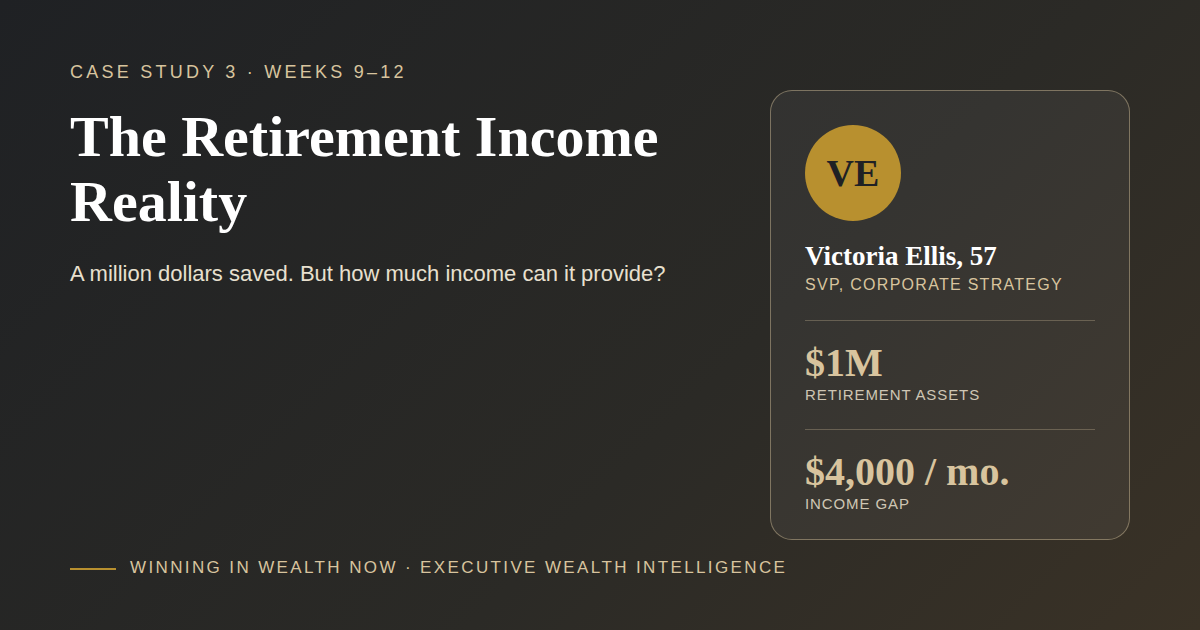
A Million Dollars Saved. But Is It Enough to Retire?
Victoria had accumulated $1 million for retirement.
But when someone asked how much monthly income that money could provide, she didn't know what to say.
Meet Victoria Ellis.
57 years old.
Senior Vice President of Corporate Strategy.
Annual compensation of approximately $310,000.
Thirty years of professional success.
Two adult children.
A beautiful life she worked hard to create.
And approximately $1 million across her retirement and investment accounts.
By almost every conventional measure, Victoria was doing well.
She had saved.
She had invested.
She had been disciplined about contributing to retirement.
She had even decided when she wanted to leave corporate leadership.
Age 62.
Five more years.
Then more time to travel, play golf, spend time with family, and pursue projects she genuinely enjoyed.
But during a conversation about retirement, someone asked her a question.
“Victoria, how much income will your retirement assets actually provide each month?”
She paused.
She knew her account balances.
She knew how her investments had performed.
She knew approximately how much she contributed each year.
But she had never translated those numbers into a coordinated retirement-income plan.
And that was the beginning of a very different financial conversation.
Because a retirement account balance is not the same thing as retirement income.
Let's look at a simplified illustration.
Suppose Victoria expects to need $8,000 per month to support her desired retirement lifestyle.
That's $96,000 annually.
Now suppose her projected Social Security and other dependable income sources total $4,000 per month.
That leaves a $4,000 monthly income gap.
Or $48,000 annually.
The question is no longer simply whether Victoria has accumulated a million dollars.
It's whether her available resources can sustainably support that $48,000 annual gap, after considering taxes, inflation, market conditions, longevity, and unexpected expenses.
And that requires more than looking at an investment statement.
Before asking whether you have enough money to retire, identify three numbers:
Your estimated monthly retirement expenses.
Your expected monthly income from Social Security, pensions, or other dependable sources.
The difference between the two.
That difference is your preliminary retirement-income gap.
It's a starting point, not a final retirement recommendation.
Victoria had spent three decades building her retirement assets.
Now she needed to understand how those assets would support her life.
Victoria discovers why having enough money on the day you retire doesn't automatically mean having enough money throughout retirement. We'll explore three risks that can quietly change the outcome: longevity, inflation, and the timing of market losses.
The Three Retirement Risks Her Portfolio Balance Couldn't Explain
Victoria thought her biggest retirement question was whether she'd saved enough.
Then she realized she needed to understand how long her money might have to last.
Last week, I introduced Victoria.
A 57-year-old senior executive with approximately $1 million in retirement and investment assets.
Her goal was to leave full-time corporate leadership at 62.
She had spent decades accumulating wealth.
But she had never built a detailed plan for converting those assets into income.
So she started looking beyond the account balance.
And three questions changed how she thought about retirement.
1. WHAT IF I LIVE LONGER THAN I EXPECT?
Victoria had imagined retiring at 62 and enjoying the next chapter of her life.
But if she lives to 92, that's 30 years of retirement.
Thirty years of housing.
Healthcare.
Travel.
Groceries.
Taxes.
Family commitments.
And everyday living expenses.
Retirement planning isn't simply about having enough money for the first five years.
It's about understanding how your resources might support you for an uncertain number of years.
2. WHAT HAPPENS WHEN THE COST OF LIVING INCREASES?
Victoria estimated that she'd want approximately $8,000 per month to support her lifestyle.
But she hadn't fully considered what inflation could do to those expenses.
Here's a hypothetical example.
If something costs $5,000 per month today, and prices rise by 3% annually, the equivalent expense would be approximately $6,720 per month ten years later.
That's an additional $1,720 per month for roughly the same purchasing power.
The 3% figure is an illustration, not a forecast.
Victoria realized her income plan needed to consider not only what she wanted to spend at retirement, but how those costs might change.
3. WHAT IF THE MARKET DECLINES JUST AS I BEGIN WITHDRAWING MONEY?
This was the risk she'd thought about the least.
While Victoria was working, market declines were uncomfortable.
But she still had a salary.
She could continue contributing.
She wasn't relying on her portfolio to pay the bills.
Retirement would change that relationship.
If she began taking withdrawals during a significant market downturn, she might have to sell more investments to generate the same amount of cash.
That could leave fewer assets available to participate in a future recovery.
This is commonly called sequence-of-returns risk.
And it's one reason two people can retire with the same amount of money and experience different outcomes.
Victoria wasn't looking for a way to eliminate every risk.
She was learning which risks her financial plan needed to manage.
Ask yourself:
How many years might my retirement need to fund?
What happens to my expenses if inflation remains elevated?
Where would my income come from if investment markets declined during my first few years of retirement?
You don't need perfect predictions.
You need a strategy that considers more than one possible future.
Victoria begins organizing her retirement resources into different income layers. Because not every retirement dollar needs to do the same job.
She Didn't Need Every Retirement Dollar to Do the Same Job
Victoria had spent 30 years asking one question about her investments: “How much can they grow?”
Now she needed to ask a different question: “What job will each part of my money perform in retirement?”
For two weeks, we've been following Victoria.
A 57-year-old senior executive preparing to retire at 62.
She has accumulated approximately $1 million in retirement and investment assets.
But she has also discovered that her account balance doesn't automatically tell her how much dependable income she'll have.
She has identified a potential retirement-income gap.
And she's begun considering longevity, inflation, and the timing of investment losses.
Now comes the strategic shift.
Instead of treating her retirement savings as one large account balance, Victoria begins thinking about the different financial responsibilities her money must support.
THE FIRST RESPONSIBILITY: ESSENTIAL INCOME
Housing.
Utilities.
Food.
Insurance.
Healthcare.
The expenses she needs to cover regardless of what financial markets are doing.
Victoria begins by identifying income sources such as Social Security and any pension benefits.
Then she evaluates how the remaining essential expenses might be supported.
THE SECOND RESPONSIBILITY: GROWTH AND PURCHASING POWER
Victoria doesn't want to spend the next 30 years watching inflation erode her lifestyle.
She still needs to evaluate investments and other resources that may support long-term growth.
But growth potential comes with risk.
And the right amount of investment risk depends on her financial needs, timeline, and ability to tolerate losses.
THE THIRD RESPONSIBILITY: LIQUIDITY AND FLEXIBILITY
Victoria loves traveling.
She wants to help her children when appropriate.
She knows that healthcare expenses, home repairs, and unexpected life events may require cash.
She doesn't want every dollar committed to an arrangement that could be costly or difficult to access.
So she begins identifying which resources should remain accessible.
THE FOURTH RESPONSIBILITY: LONG-TERM PROTECTION AND LEGACY
Victoria also wants to understand what happens if she lives longer than expected, requires significant care, or dies with assets remaining.
She needs to coordinate retirement income with insurance, beneficiaries, and estate planning.
Here's what she discovers.
Different financial tools solve different problems.
Social Security may provide an important foundation of lifetime income.
Pensions, where available, may provide contractual payments under specific terms.
Investment portfolios may support growth and flexible withdrawals but are exposed to market risk.
Certain annuities may provide contractual income guarantees, depending on their terms, costs, and the issuing insurer's claims-paying ability.
Cash reserves may provide accessibility, but their purchasing power can decline over time.
None of these tools is automatically the best solution for every retiree.
And no single product should be expected to solve every retirement problem.
Create four headings:
ESSENTIAL INCOME | LONG-TERM GROWTH | LIQUIDITY | PROTECTION AND LEGACY
Under each, list the financial resources you currently have.
Then ask:
What is each resource supposed to accomplish?
Where are the gaps?
Where might I be relying too heavily on one account, asset, or strategy?
Victoria didn't suddenly need more financial products.
She needed to understand how her existing resources could work together.
Victoria completes her retirement-income readiness review. And we'll examine the questions every high-earning professional should ask before deciding when to retire or how to draw income from their savings.
The Retirement Readiness Review Every High Earner Should Complete
Victoria didn't need someone to tell her whether $1 million was enough to retire.
She needed a way to determine what “enough” meant for her life.
Four weeks ago, we met Victoria.
57 years old.
Senior Vice President.
Annual compensation of approximately $310,000.
Approximately $1 million in retirement and investment assets.
A successful career.
A retirement date in mind.
And one unanswered question:
“How do I know whether the money I've accumulated will support the life I want after I stop working?”
Over the last four weeks, Victoria has made four important discoveries.
First, a retirement account balance isn't a retirement-income plan.
Second, longevity, inflation, and market volatility can affect how long retirement assets last.
Third, different financial resources have different responsibilities.
And fourth, retirement readiness should be evaluated through a coordinated plan—not a single savings target.
So Victoria created her first Retirement Income Readiness Review.
Here are the questions she used.
1. WHAT WILL MY RETIREMENT ACTUALLY COST?
Not just the mortgage and groceries. Travel. Healthcare. Taxes. Family support. And the lifestyle I want to enjoy.
2. WHAT DEPENDABLE INCOME CAN I REASONABLY EXPECT?
Social Security. Pensions, if applicable. Other contractual or recurring income sources. And when those payments are expected to begin.
3. WHAT INCOME GAP WILL MY INVESTMENTS AND OTHER ASSETS NEED TO SUPPORT?
How much will I need to withdraw each month or year? And how could that change over time?
4. WHAT HAPPENS IF THE MARKET PERFORMS POORLY EARLY IN RETIREMENT?
Do I have sufficient flexibility to avoid making costly decisions during a downturn?
5. HOW WILL INFLATION AFFECT MY PURCHASING POWER?
What assumptions am I using? And how will I review them as circumstances change?
6. HOW MUCH LIQUIDITY SHOULD REMAIN AVAILABLE?
What money might I need for unexpected expenses without triggering unnecessary charges, taxes, or investment sales?
7. HOW WILL TAXES AFFECT MY RETIREMENT INCOME?
Different accounts can have different tax treatment. The order and timing of withdrawals may affect what I actually keep.
8. WHAT HAPPENS IF I LIVE LONGER THAN EXPECTED?
How will my income strategy respond if retirement lasts 25, 30, or more years?
9. WHAT HAPPENS TO THE ASSETS I DON'T SPEND?
Are my beneficiary designations, insurance arrangements, and estate documents coordinated with my wishes?
10. WHO IS HELPING ME EVALUATE THE COMPLETE PICTURE?
Do the financial, tax, insurance, and legal professionals involved understand how their recommendations interact?
Victoria didn't answer every question in one afternoon.
And she didn't need to.
She had something more useful.
A clear framework for evaluating her readiness—and a better understanding of the decisions that needed professional attention.
She also realized that retirement wasn't simply about leaving her job.
It was about having the financial capacity to choose how she wanted to spend her time.
Choose your intended retirement age.
Estimate your annual retirement spending.
Identify expected dependable income.
Calculate the preliminary income gap.
Then review that gap against your available assets, tax considerations, liquidity needs, and retirement timeline.
If you cannot confidently explain how the pieces fit together, that is a reason to examine the plan—not a reason to panic.
Your retirement deserves more than a number. It deserves a strategy.
Victoria's journey introduced an important question: How can someone evaluate retirement-income options while managing market risk, growth expectations, and the need for flexibility? Next, we'll examine What a Fixed Indexed Annuity Does—and Doesn't Do. Not the sales pitch. The actual features, limitations, costs, and questions worth asking.
From accumulation to income clarity
“I have $1 million saved. But what income can it provide?”
“My retirement plan must account for time, inflation, and market risk.”
“Different parts of my money need different responsibilities.”
“I can evaluate my retirement readiness with a coordinated framework.”
Retirement Income Gap Snapshot
A preliminary subtraction exercise, not a retirement-income projection. It does not account for taxes, benefit timing, inflation, portfolio returns, withdrawals, or other risks.
See where you stand. Talk to a licensed professional.
Victoria Ellis is a fictional composite created for education. All figures are hypothetical illustrations, not client results, quotes, or guarantees. Educational information only; not tax, legal, insurance, or investment advice. Product availability varies by state.