The Business Owner's Wealth Paradox
One successful entrepreneur. Seven financial decisions. Four weeks that reveal why building a profitable business and building personal wealth are not necessarily the same thing.
Marcus isn't a struggling entrepreneur. He has built something meaningful. He pays his employees, serves his clients, supports his family, and carries responsibilities that most people never see. But he is beginning to question whether the company he built is also building the personal financial future he wants.
Companion article: Seven Financial Decisions Business Owners Should Coordinate
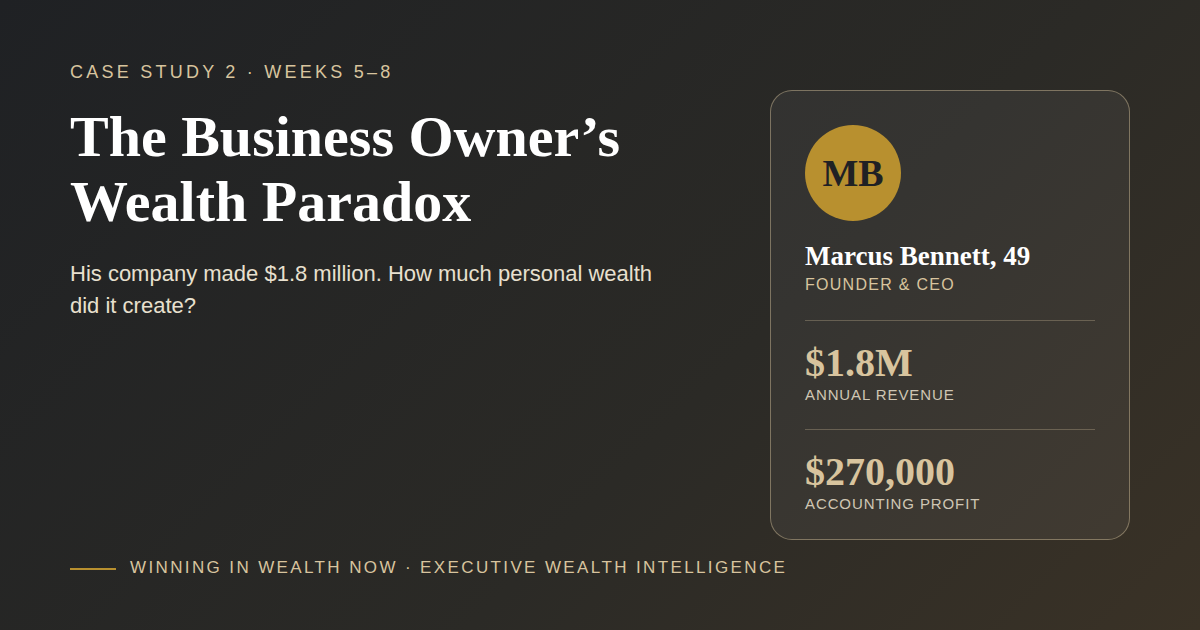
Marcus Bennett, 49
- Business
- Founder and CEO of a commercial facilities management company
- Annual company revenue
- $1.8 million
- Personal annual compensation
- Approximately $230,000
- Family
- Married, two teenagers, aging parents
- Business stage
- 12 years in operation, 18 employees
- Financial reality
- Profitable company, significant business obligations, retirement savings behind his personal goals, and much of his wealth concentrated in the business
Your Business Can Be Successful While Your Personal Wealth Falls Behind
His business generated $1.8 million last year. But he couldn't tell you exactly how much personal wealth it created.
Meet Marcus.
49 years old.
Founder and CEO.
Twelve years in business.
Eighteen employees.
A company generating approximately $1.8 million in annual revenue.
He'd built a business that clients trusted, employees depended on, and his family was proud of.
And he had every reason to celebrate.
But one evening, after reviewing the company's financial statements, Marcus found himself thinking about something he'd been avoiding.
He knew his company's revenue.
He knew his payroll.
He knew what his largest clients owed.
He knew what equipment needed replacing.
He even knew which contracts were coming up for renewal.
But he couldn't answer one question with confidence.
“How much personal wealth am I actually building outside this business?”
Marcus wasn't broke.
He paid himself approximately $230,000 annually.
His family lived comfortably.
He owned a home.
He had retirement savings.
But most of his attention—and much of his financial exposure—remained tied to the company.
And he realized something uncomfortable.
Business revenue is not business profit.
Business profit is not personal income.
And personal income is not automatically personal wealth.
A company can generate seven figures in revenue while its owner has limited accessible reserves, insufficient retirement assets, or significant personal financial exposure to the business.
This isn't necessarily a failure of entrepreneurship.
It's what can happen when the business grows faster than the financial systems surrounding its owner.
Marcus had spent twelve years asking:
“How do I make this business more successful?”
Now he needed to ask:
“How do I make sure the success of this business is also creating financial security for my family?”
That question changed the conversation.
If you own a business, write down these four numbers:
Your company's annual revenue.
Your company's actual profit.
Your total personal compensation from the business.
The amount you contributed to personal assets outside the business last year.
Don't assume those numbers tell the same story.
They often don't.
Marcus discovers why his business can look profitable on paper while his personal financial life still feels unpredictable.
The Business Is Profitable. So Why Does Cash Still Feel Tight?
Marcus owned a profitable seven-figure business. Yet some months, he hesitated before transferring money into his personal account.
Last week, I introduced Marcus.
A 49-year-old entrepreneur whose commercial facilities company generated $1.8 million in annual revenue.
His business was successful.
But he was beginning to realize that business success and personal financial security required different decisions.
So Marcus took a closer look at the company's money.
And the problem became clearer.
Some months, clients paid quickly.
Other months, invoices remained outstanding while payroll, insurance, equipment, and operating expenses were still due.
A profitable contract didn't always produce immediate cash.
And Marcus had developed a habit of adjusting his personal compensation whenever the business needed more money.
When cash was abundant, he took additional distributions.
When cash was tight, he reduced what he paid himself.
Meanwhile, taxes, debt payments, and future equipment needs weren't always being coordinated with those decisions.
He wasn't necessarily making bad decisions.
He was responding to competing responsibilities without one integrated system.
Consider a simplified example.
| Illustration | Amount |
|---|---|
| Annual revenue | $1,800,000 |
| Operating expenses (including his compensation, excluding income taxes and principal repayments) | $1,530,000 |
| Accounting profit under these assumptions | $270,000 |
That leaves $270,000 in accounting profit under these assumptions.
But that profit is not necessarily $270,000 sitting in the bank.
Receivables, loan principal payments, equipment purchases, tax obligations, and working-capital needs can all affect available cash.
And Marcus still has a personal financial life to fund.
This is why three business-owner decisions must be coordinated:
1. BUSINESS CASH FLOW AND PERSONAL COMPENSATION
How much can the business sustainably pay the owner without weakening operations?
2. TAX PLANNING
What tax obligations should be anticipated, and how do business structure, compensation, and retirement contributions affect the plan?
3. DEBT AND CAPITAL
Which obligations support productive growth, and which create pressure on future cash flow?
These decisions affect one another.
A large owner distribution can reduce operating reserves.
An unplanned tax obligation can force borrowing.
An expensive financing decision can reduce the cash available for both business growth and personal wealth building.
Marcus didn't need to stop investing in his company.
He needed to stop treating every financial decision as though it existed independently.
Ask yourself:
Do I have a reliable cash-flow forecast?
Is my personal compensation planned or reactive?
Am I setting aside money for expected taxes?
Do I know how much cash my business needs to operate through a slower period?
Can I clearly distinguish business debt from personal financial obligations?
The objective isn't to withdraw as much money as possible from your company.
It's to build a business that can support its obligations while helping you achieve your personal financial goals.
Marcus realizes his greatest financial risk may be the very business he's spent twelve years building. We'll examine personal wealth accumulation, protection, and business continuity.
What Happens to Your Wealth If Something Happens to Your Business?
Marcus spent twelve years building an asset worth protecting. But he had never seriously asked what would happen if he couldn't run it.
By the third week of reviewing his financial life, Marcus had begun to see the bigger picture.
He understood his business revenue.
He was taking a closer look at cash flow, taxes, debt, and owner compensation.
But then his wife asked him a question.
“If you couldn't work for the next six months, what would happen to the company—and to us?”
Marcus had an answer for almost every operational problem.
He had backup vendors.
He had emergency maintenance procedures.
He had people who could manage customer relationships.
But he had never fully coordinated what would happen if he became seriously ill, disabled, or unexpectedly died.
And that exposed two additional financial decisions.
DECISION 4: BUILD PERSONAL WEALTH OUTSIDE THE BUSINESS.
Marcus had reinvested heavily in the company.
That reinvestment helped the business grow.
But it also meant that much of his financial future depended on one enterprise.
The company's value was not the same as having diversified, accessible personal assets.
A business may be valuable and still be difficult to sell.
A profitable company may experience a downturn.
And a business owner's retirement shouldn't automatically depend on finding a buyer willing to pay the expected price.
Marcus began asking:
How much of my family's wealth is concentrated in this business?
What am I building outside it?
Am I contributing consistently to personal savings and retirement accounts?
DECISION 5: PROTECT THE PEOPLE AND OPERATIONS THAT DEPEND ON THE BUSINESS.
Insurance and continuity planning aren't only about buying policies.
They're about identifying what could happen and how the financial consequences would be managed.
For Marcus, that meant reviewing:
What happens if he cannot work?
Who can operate the business in his absence?
How would the family replace lost income?
Does the company depend on another person whose loss would create a major financial disruption?
Are ownership agreements and insurance arrangements coordinated?
Some risks can be insured.
Others require operating procedures, cash reserves, legal agreements, or succession planning.
Ask yourself two questions:
1. If my business stopped generating income for six months, which personal financial obligations could I still meet?
2. If I were unavailable tomorrow, who would have the authority, information, and resources to keep the company operating?
These aren't pessimistic questions.
They're leadership questions.
Marcus had spent years protecting the business from operational risk.
Now he was learning to protect his family's future from unnecessary dependence on that business.
Marcus faces the two decisions he'd been postponing: retirement and succession. Because building a company is one achievement. Building something that can support your life—and potentially continue beyond your leadership—is another.
The Business You Built Should Support the Life You Want to Live
Marcus built a $1.8 million-revenue company. But he had never defined what financial freedom from that company would actually look like.
Four weeks ago, we met Marcus.
49 years old.
Twelve years in business.
Eighteen employees.
A company that had become one of the most important achievements of his life.
But Marcus was beginning to understand something.
A business can provide income.
It can create opportunity.
It can build significant value.
But it doesn't automatically provide a retirement plan, a succession strategy, or a lasting financial legacy.
Those outcomes require their own decisions.
Over the last three weeks, Marcus examined:
Business cash flow.
Personal compensation.
Tax planning.
Debt and financing.
Personal wealth accumulation.
Insurance and business continuity.
Now he was ready to address the final two pieces.
DECISION 6: RETIREMENT PLANNING
Marcus had assumed he would eventually sell his company.
But he had never established how much retirement income he needed—or how much of that income would have to come from a future business sale.
What if the market wasn't favorable when he wanted to retire?
What if the company sold for less than expected?
What if he decided to step away before finding a buyer?
He realized a potential sale could be part of his retirement strategy.
It shouldn't be the only strategy.
So he began reviewing retirement savings, available employer-sponsored retirement-plan options, personal investments, expected future income, and the tax consequences of different decisions.
DECISION 7: ESTATE PLANNING, SUCCESSION, AND LEGACY
Marcus also needed to answer a different question.
What happens to everything he's built when he is no longer making the decisions?
Who would lead the business?
Who would own it?
How would its value be determined?
What would his family receive?
And how would the business transition without creating unnecessary confusion for his employees or heirs?
These questions require coordination among financial, tax, legal, and insurance professionals.
But they begin with the owner.
THE BUSINESS OWNER'S SEVEN-DECISION AUDIT
Here are the seven areas Marcus committed to reviewing:
Business cash flow and personal compensation.
Personal wealth accumulation outside the company.
Tax planning.
Debt and capital.
Insurance and business continuity.
Retirement planning.
Estate, succession, and legacy planning.
Not seven products to buy.
Seven decisions to coordinate.
Rate your current level of clarity in each of those seven areas:
1 = I haven't addressed this.
3 = I have some pieces in place.
5 = I have a documented, coordinated plan that I review.
Then identify your lowest-scoring area.
That is where your next financial conversation may need to begin.
Marcus didn't leave this process with every answer.
He left with something more useful than assumptions.
A clearer picture of what needed attention, who needed to be involved, and how to begin.
Your company should not be the only thing growing while you build your business.
Your financial independence, protection, retirement readiness, and legacy deserve intentional attention too.
We're following a senior executive approaching retirement who has accumulated substantial assets—but is discovering that having enough money saved and knowing how to turn it into dependable retirement income are two different challenges. Next in The Executive Wealth Intelligence Series: How to Evaluate a Retirement-Income Strategy.
From business success to personal wealth
Revenue is not personal wealth.
Cash flow, compensation, taxes, debt.
Personal assets and business continuity.
Retirement, succession, legacy.
The Seven-Decision Clarity Score
See where you stand. Talk to a licensed professional.
Marcus Bennett is a fictional composite created for education. All figures are hypothetical illustrations, not client results, quotes, or guarantees. Educational information only; not tax, legal, insurance, or investment advice. Product availability varies by state.