The Numbers Behind the Promise
Two annuity illustrations. Two very different crediting formulas. One accomplished woman determined to understand what the numbers actually mean before making a decision.
Elena understands the basic concept of a fixed indexed annuity, but she has encountered something many sophisticated investors find confusing: two contracts can reference market indexes, offer a 0% index-interest floor, and still produce very different credited interest. Her story unfolds like a financial mystery—every installment answers one question and reveals another.
Companion article: Fixed Indexed Annuity Caps, Participation Rates, and Crediting Explained
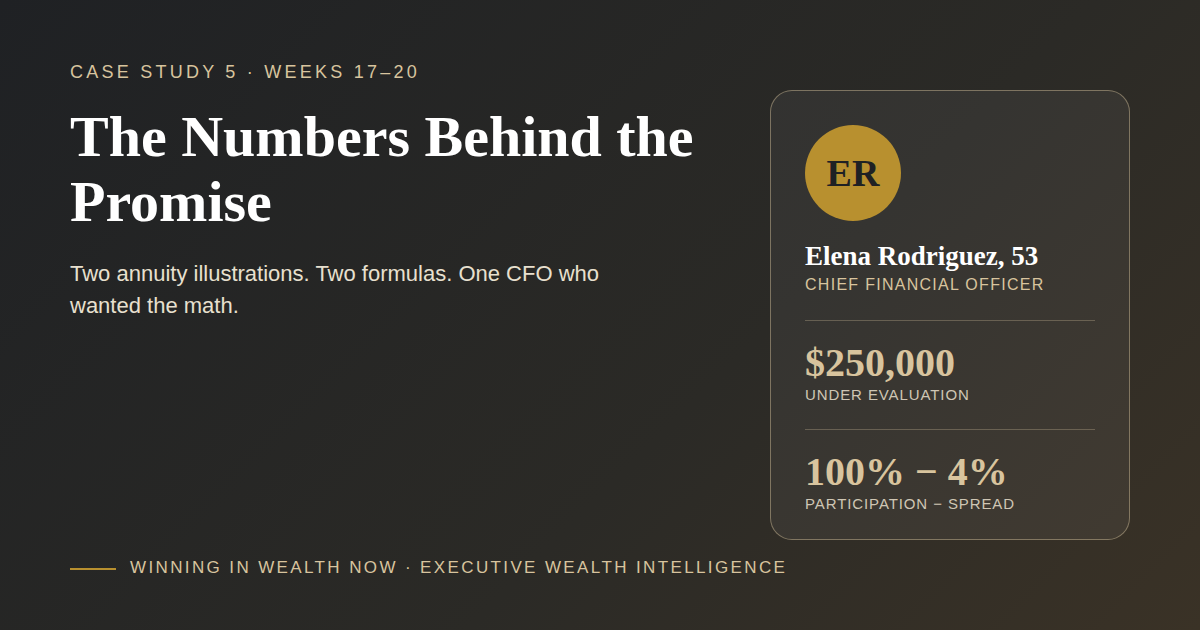
Elena Rodriguez, 53
- Career
- Chief Financial Officer of a privately held logistics company
- Annual compensation
- Approximately $340,000, including incentives
- Retirement and investment assets
- Approximately $1.6 million
- Family
- Married, one adult son and a daughter in college
- Financial decision
- Whether to allocate $250,000 of her retirement assets to a fixed indexed annuity
- Retirement horizon
- Approximately 9 years
The 10% Market Gain That Didn't Become a 10% Interest Credit
Elena was reviewing two retirement-income illustrations when she noticed something that didn't make sense.
Both contracts referenced market indexes.
Both described protection from negative index-interest credits.
Both presented opportunities for interest accumulation.
But the projected results were different.
And the more Elena looked at the illustrations, the more questions she had.
Meet Elena Rodriguez.
53 years old.
Chief Financial Officer.
Annual compensation of approximately $340,000.
Nearly three decades of experience managing financial decisions.
And approximately $1.6 million in retirement and investment assets.
Elena wasn't new to investing.
She understood financial statements.
She understood risk.
She understood that higher potential returns often came with trade-offs.
But she was now evaluating whether to place $250,000 of her retirement assets into a fixed indexed annuity.
And she wanted to understand something very specific.
“If the market index rises 10%, how much interest will my contract actually earn?”
It sounded like a simple question.
But the answer depended on the contract's crediting formula.
That's because a fixed indexed annuity doesn't typically credit the full return of the index it references.
Instead, the insurance company applies a contract-defined formula.
That formula may include:
A cap.
A participation rate.
A spread.
A crediting period.
Or a combination of these features.
Let's look at a simplified example.
Suppose the relevant index rises 10% over a one-year crediting period.
Contract A uses a 7% cap.
Under a straightforward cap-only formula, the contract would credit 7%.
Contract B uses a 60% participation rate with no cap or spread in this illustration.
Under that formula, the contract would credit 6%.
| Hypothetical index gain +10% | Credited |
|---|---|
| 7% cap strategy | 7% |
| 60% participation strategy | 6% |
Same hypothetical index gain.
Different credited interest.
And neither contract would necessarily credit the full 10%.
Elena realized that a familiar index name didn't tell her how much interest she would earn.
The formula did.
And that's where her evaluation needed to begin.
If you're reviewing an indexed annuity, identify:
The exact index used.
The crediting period.
The formula used to calculate interest.
The cap, participation rate, or spread, where applicable.
Whether and when those terms may change.
Don't stop at the phrase “market-linked growth.”
Ask what the contract actually credits.
Elena discovers that a cap and a participation rate can produce different results depending on what the market does. And the contract that looks more attractive in one scenario may not be the more attractive one in another.
A 7% Cap or a 60% Participation Rate: Which Is Better?
Elena thought the annuity with the 7% cap was the better option.
Then she changed one number in her comparison.
Last week, I introduced Elena.
A 53-year-old CFO evaluating two hypothetical fixed indexed annuity crediting strategies.
One used a 7% cap.
The other used a 60% participation rate.
When the index gained 10%, the cap strategy credited 7%, while the participation strategy credited 6%.
At first glance, the cap strategy looked more attractive.
But Elena knew better than to evaluate a financial decision using one favorable scenario.
So she asked:
“What happens if the index rises by only 5%? What happens if it rises by 20%?”
Let's compare the formulas.
Scenario 1: The index rises 5%. With a 7% cap, a simplified cap-only strategy credits 5%. With a 60% participation rate, a simplified participation-only strategy credits 3%.
Scenario 2: The index rises 10%. The cap strategy credits 7%. The participation strategy credits 6%.
Scenario 3: The index rises 20%. The cap strategy still credits 7%. The participation strategy credits 12%, assuming there is no additional cap or spread.
| Index gain | 7% cap | 60% participation |
|---|---|---|
| 5% | 5% | 3% |
| 10% | 7% | 6% |
| 20% | 7% | 12% |
Suddenly, Elena could see something important.
A cap places a ceiling on the amount of interest credited.
A participation rate determines what percentage of the measured index gain is used in the crediting calculation.
Neither feature automatically makes a contract better.
The result depends on the index movement, the complete formula, the crediting period, and the actual contract terms.
And Elena wasn't done asking questions.
She wanted to know whether the insurer could change the cap or participation rate after the first year.
Because a rate available today may not remain the same for the entire contract.
Some contracts specify guaranteed minimum or maximum parameters and allow renewal crediting terms to change within those contractual limits.
So Elena asked for both the current rates and the contractual guarantees.
That distinction matters.
An attractive initial rate isn't the same as a guaranteed rate for ten years.
When comparing two annuity strategies:
Calculate the credited interest under a modest index gain.
Calculate it under a larger gain.
Calculate it under a negative index change.
Ask which terms can change and what contractual limits apply.
Don't compare a cap and a participation rate as though they are interchangeable numbers.
They're different mathematical tools.
Elena receives a third illustration. This one advertises a 100% participation rate. At first, it sounds more attractive than the others. Until she discovers the spread.
The 100% Participation Rate That Didn't Tell the Whole Story
Elena was offered an annuity strategy with a 100% participation rate.
She almost stopped reading there.
After all, 100% sounded better than 60%.
And it certainly sounded more attractive than a 7% cap.
But Elena had spent enough time evaluating financial decisions to know that one impressive number rarely tells the whole story.
So she asked for the complete crediting formula.
And that's when she noticed something else.
A 4% spread.
In a simplified spread-based strategy, a spread is an amount deducted from the measured index change before the interest credit is determined.
Let's use a hypothetical example.
Suppose the index rises 10%.
The contract applies a 100% participation rate.
Then subtracts a 4-percentage-point spread.
Under that simplified formula, the interest credit would be:
10% − 4% = 6%.
Not 10%.
Now suppose the index rises only 3%.
With a 4% spread and a 0% index-interest floor, the contract would credit 0%.
And if the index rises 20%, the same simplified formula would credit 16%, assuming no other cap or limitation applies.
| Index change | Hypothetical credit |
|---|---|
| +3% | 0% |
| +10% | 6% |
| +20% | 16% |
| −10% | 0% |
Suddenly, that 100% participation rate looked very different.
Not necessarily bad.
Just incomplete without the rest of the formula.
Elena realized she needed to understand three different concepts.
A CAP limits the maximum interest credit.
A PARTICIPATION RATE determines how much of the measured index gain is used.
A SPREAD reduces the gain used in the interest calculation.
Some contracts use one of these features.
Others combine them.
And different index strategies within the same annuity may use different formulas.
There was another question Elena hadn't considered.
“What happens if the index rises during the year but finishes the crediting period below where it started?”
Depending on the measurement method, the contract might credit no index-linked interest for that period.
That doesn't necessarily mean the index never increased during the year.
It means the contract measures performance according to specific dates and rules.
This is why the crediting period and index methodology matter.
A one-year point-to-point calculation is different from a monthly averaging strategy.
And a custom volatility-controlled index may behave differently from a familiar broad-market benchmark.
Before evaluating an advertised annuity rate, request:
The full interest-crediting formula.
Any cap, participation rate, and spread that apply together.
The exact index and how its return is measured.
The crediting period and observation dates.
The guaranteed limits on future rate changes.
Then ask for a written example showing the calculation.
You should be able to explain the formula in plain English before making a long-term commitment.
Elena has compared caps, participation rates, and spreads. Now she needs to answer the question that matters most: Does the contract's complete design make sense for her retirement strategy? We'll finish with the decision checklist she uses before moving forward.
Before She Signed, the CFO Asked 10 Questions
Elena didn't reject the annuity.
She rejected the idea of making a decision she couldn't fully explain.
Four weeks ago, we met Elena Rodriguez.
53 years old.
Chief Financial Officer.
Approximately $1.6 million in retirement and investment assets.
Considering whether $250,000 should be allocated to a fixed indexed annuity.
She had received multiple illustrations.
And each presented an attractive-looking number.
One showed a 7% cap.
Another showed a 60% participation rate.
A third showed 100% participation with a 4% spread.
At first, Elena wanted to know which one was best.
But as she examined the formulas, she realized she was asking the wrong question.
The best-looking rate isn't necessarily the best financial decision.
Because an annuity's suitability depends on much more than the amount of interest it might credit.
Elena needed to understand the entire contract.
So she created a checklist.
THE 10 QUESTIONS ELENA ASKED BEFORE MAKING A DECISION
1. What role would this annuity play in my overall retirement plan? Would it support accumulation, future income, or another defined objective?
2. What exact index and crediting method does the contract use? Not just the index name. The actual measurement method.
3. How do the cap, participation rate, and spread work together? She wanted written examples under different index conditions.
4. Which crediting terms can change? And what minimum or maximum terms are guaranteed by the contract?
5. What happens during a year when the index declines? She wanted to understand the index-interest floor and any other charges that could affect contract values.
6. What are the surrender charges and withdrawal restrictions? And how long would those restrictions apply?
7. Are there rider fees or other contract costs? And how would those costs affect the values and benefits being illustrated?
8. What financial obligations am I accepting in exchange for the contract's protections? She wanted to understand the trade-off between growth potential, guarantees, liquidity, and flexibility.
9. How financially strong is the issuing insurance company? Because contractual guarantees depend on the insurer's claims-paying ability.
10. How does this compare with my alternatives? Including other annuities, fixed-income investments, cash reserves, and her existing portfolio.
Elena also asked one final question.
“Can you explain why this particular contract is appropriate for my situation—not simply why its features sound attractive?”
That question matters.
Because a financial illustration is not a substitute for an individualized evaluation.
And hypothetical credited interest is not the same as guaranteed investment performance.
By the end of the month, Elena hadn't selected a contract.
She had done something more important.
She had learned how to evaluate one.
She understood the formulas.
She knew what information to request.
And she could compare the potential benefits with the costs, restrictions, and alternatives.
If you're considering a fixed indexed annuity, request the current contract illustration and disclosure materials.
Identify the full crediting formula.
Review the guaranteed and nonguaranteed terms.
Calculate hypothetical credits under multiple scenarios.
And discuss how the contract fits your complete financial plan with an appropriately licensed professional.
Don't confuse complexity with sophistication.
A financial decision should become clearer as you understand it—not more mysterious.
Elena's journey showed us why understanding a contract matters before committing retirement assets. Next, we follow a successful woman who has heard that permanent life insurance can provide more than a death benefit—including potential access to accumulated cash value: What to Understand Before Buying Life Insurance With Cash Value. Because wealth strategies deserve more than compelling promises. They deserve informed decisions.
From attractive numbers to informed comparison
“The index's return isn't necessarily my interest credit.”
“A cap and a participation rate behave differently under different scenarios.”
“A headline participation rate doesn't tell me the complete formula.”
“I can evaluate the full contract and its alternatives before deciding.”
Indexed Interest Crediting Simulator
Educational examples only. Assumes one-year index measurement, a 0% index-interest floor, and independent formulas without other adjustments. Actual contracts may include additional limitations, changing crediting terms, rider fees, and withdrawal provisions. Not an insurer illustration or recommendation.
See where you stand. Talk to a licensed professional.
Elena Rodriguez is a fictional composite created for education. All figures are hypothetical illustrations, not client results, quotes, or guarantees. Educational information only; not tax, legal, insurance, or investment advice. Product availability varies by state.