The High-Income Wealth Gap
Four weeks. One woman. Four financial realizations that change how she thinks about wealth.
Danielle Brooks is a fictional but realistic composite of the accomplished women we serve. She is not financially irresponsible. She is not someone who needs a lecture about budgeting. She is a highly capable professional who has built an impressive career—and is beginning to recognize that professional success and financial freedom are two different achievements.
Companion article: Why High Income Doesn't Automatically Create Wealth
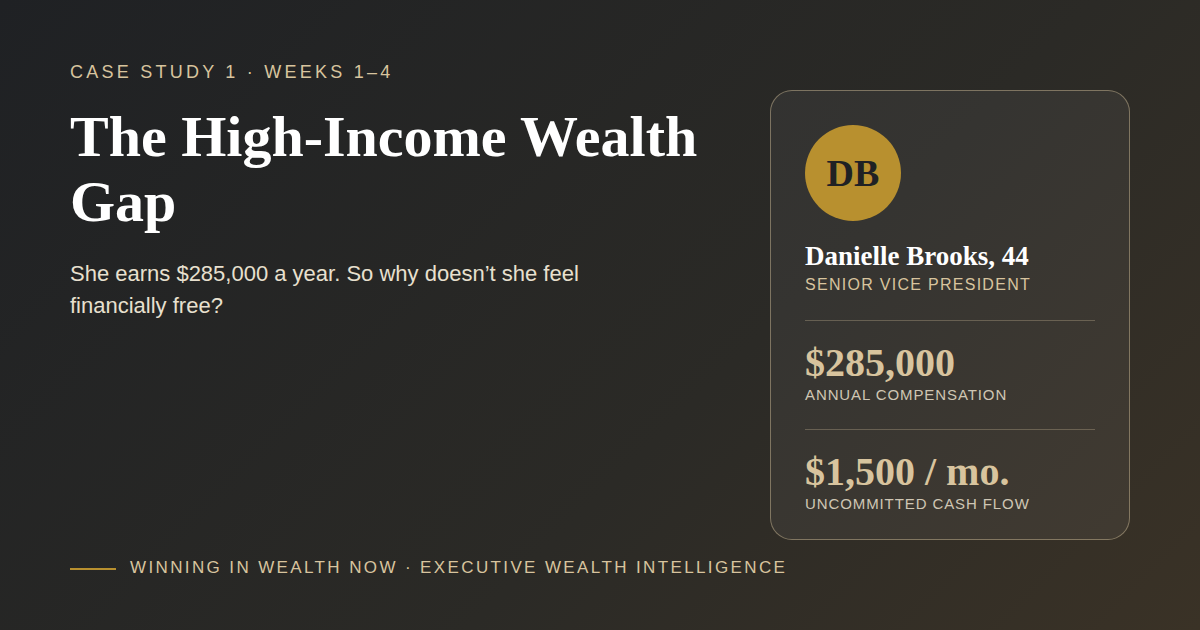
Danielle Brooks, 44
- Career
- Newly promoted Senior Vice President of Operations
- Annual compensation
- $285,000, including bonus
- Family
- Married, two children
- Financial position
- Substantial home equity, retirement savings, good income—but limited accessible reserves relative to her obligations
The Income Illusion
She just received a promotion to $285,000 a year. So why doesn't she feel financially free?
At 44, Danielle had reached a level in her career she once dreamed about.
Senior Vice President.
A respected leader.
A beautiful home.
Two children in good schools.
A retirement account she'd been contributing to for years.
And now, a compensation package approaching $300,000.
From the outside, everything looked like success.
But a few weeks after celebrating her promotion, Danielle sat down to review her family's finances.
And something bothered her.
Her income had increased significantly over the years.
Her lifestyle had improved.
Her home had appreciated.
Her retirement account had grown.
Yet the amount of money she could comfortably access without borrowing, selling an asset, or disrupting another financial goal was smaller than she expected.
She wasn't struggling to pay her bills.
She was struggling to understand why she still felt so dependent on her next paycheck.
Here's what Danielle was beginning to discover:
Income is what you earn.
Net worth is what you own minus what you owe.
Liquidity is what you can access when life requires cash.
And financial independence is about having sufficient resources to support your life without depending entirely on continued employment.
They are related.
But they are not interchangeable.
You can earn $285,000, have a seven-figure net worth, and still feel financially vulnerable if most of your wealth is tied up in assets that are difficult or costly to access.
That doesn't make you unsuccessful.
It means your financial structure deserves the same attention you've given your career.
Ask yourself:
What is my approximate net worth?
How much money could I access within seven days without taking on new debt?
How many months of essential expenses could that money cover?
Don't judge the answers.
Use them as information.
Because you cannot intentionally improve what you have never clearly measured.
Danielle discovers where a surprising amount of her financial capacity has been going—and why her promotion alone won't solve it.
The Hidden Cost of a High-Income Lifestyle
Danielle earned $285,000. But her lifestyle had quietly become dependent on nearly every dollar.
Last week, I introduced Danielle.
A 44-year-old senior executive who had just received another promotion.
Her career was thriving.
But she had begun questioning why her financial freedom didn't reflect her professional success.
So Danielle did something many accomplished professionals postpone.
She looked closely at where her money was going.
Not because she was irresponsible.
Because her financial obligations had expanded alongside her income.
The mortgage.
Childcare and education.
Insurance.
Transportation.
Family support.
Travel.
Debt payments.
The conveniences that helped two busy professionals manage demanding careers.
None of these expenses seemed unreasonable on its own.
Together, they told a different story.
Let's use a simplified illustration.
| Monthly picture | Amount |
|---|---|
| Available after taxes and payroll deductions | $16,000 |
| Spending and other cash commitments | $14,500 |
| Uncommitted cash flow | $1,500 |
| Per year | $18,000 (9.4%) |
Suppose Danielle's household had $16,000 per month available after taxes and payroll deductions.
And suppose its spending and other cash commitments averaged $14,500.
That would leave approximately $1,500 per month in uncommitted cash flow.
That's $18,000 per year—or 9.4% of the amount available after those deductions.
This example is not a complete savings-rate calculation. Retirement contributions may already be deducted, and a proper review would account for them.
But it reveals something important.
A high income does not automatically produce a high level of financial flexibility.
And a promotion can make the situation worse if every additional dollar is assigned to a new obligation.
Danielle realized her financial challenge wasn't simply about making more money.
It was about deciding what her money needed to accomplish before her lifestyle made those decisions for her.
Review the last three months of your household spending.
Identify:
Your fixed financial commitments.
Your discretionary spending.
Your debt payments.
Your actual contributions toward accessible reserves and long-term assets.
Then ask:
If my income increased by $50,000 next year, how much of that increase would I intentionally direct toward building wealth?
The answer matters more than the size of the raise.
In Part 3, Danielle begins changing the way she organizes her money. Not with a restrictive budget. With a financial system designed around the future she's working so hard to create.
Building a Financial System That Matches Her Success
Danielle knew how to manage a multimillion-dollar department. But she'd never built a financial operating system for her own household.
That realization changed the conversation.
At work, Danielle didn't leave important outcomes to chance.
She had budgets.
Forecasts.
Risk controls.
Performance reviews.
Contingency plans.
Every major resource had a purpose.
But at home?
Her family had accounts.
A mortgage.
Insurance policies.
Retirement contributions.
Some investments.
And a collection of financial decisions made at different stages of life.
What they didn't have was a coordinated system showing how those decisions worked together.
Danielle wasn't starting from zero.
She had spent years building assets.
She simply needed to understand whether those assets were positioned to support the freedom she wanted.
So she began organizing her financial life around five priorities.
1. CASH FLOW
How much income is coming in, how much is committed, and how much can be intentionally directed toward future goals?
2. LIQUIDITY
What resources are accessible when an emergency, career transition, or opportunity requires cash?
3. DEBT
Which obligations are supporting long-term objectives, and which are unnecessarily consuming financial capacity?
4. WEALTH ACCUMULATION
What portion of her income is consistently building assets for the future, and is her overall investment strategy aligned with her goals?
5. PROTECTION AND RETIREMENT
What would happen to the plan if her income stopped, her health changed, or she decided to retire earlier than expected?
Danielle realized these weren't five unrelated financial topics.
They were five connected responsibilities.
A strong retirement account cannot replace an emergency reserve.
A valuable home doesn't automatically provide monthly retirement income.
And an impressive salary doesn't guarantee that the people depending on you are adequately protected.
Create five headings on a blank page:
CASH FLOW | LIQUIDITY | DEBT | ACCUMULATION | PROTECTION
Under each heading, write:
What is working?
What concerns me?
What information am I missing?
What decision needs attention?
You don't need to solve everything today.
You need to see the whole picture.
Because a successful career deserves an intentional financial strategy.
Danielle completes her first Executive Wealth Audit—and identifies the numbers that will guide her next chapter.
The Executive Wealth Audit
Danielle didn't need another promotion to begin building a different financial future.
She needed clarity.
Four weeks ago, we met Danielle.
A 44-year-old executive earning $285,000 annually.
She had a successful career, substantial assets, and a life she'd worked hard to build.
But she also had a question she couldn't ignore:
“If I'm doing this well professionally, why don't I feel as financially free as I expected?”
She started by separating income from wealth.
Then she examined how her financial obligations had expanded.
Next, she began coordinating her cash flow, liquidity, debt, asset accumulation, and protection.
Now came the most important step.
Turning that awareness into measurable action.
Danielle created her first Executive Wealth Audit.
Not to criticize the decisions she'd made.
To understand where she stood and what needed attention.
Here are the five numbers she chose to review.
1. NET WORTH
Total assets minus total liabilities.
This gave her a starting point for measuring changes in her overall financial position.
2. ACCESSIBLE RESERVES
How much money could she access without borrowing or selling long-term assets at an inconvenient time?
3. SAVINGS AND INVESTMENT RATE
What percentage of household income was consistently directed toward building financial assets?
4. DEBT OBLIGATIONS
How much of the household's monthly cash flow was committed to debt payments—and what did those obligations cost?
5. RETIREMENT-INCOME PROGRESS
How much future income might her current savings and other expected resources support, compared with the retirement lifestyle she wanted?
Danielle didn't have perfect answers to every question.
But she finally had a way to measure progress that wasn't based on her title, compensation, or the value of her home.
And that changed something.
Instead of asking, “How do I make more money?”
She began asking:
“How do I make the money I've already earned work more intentionally toward the life I want?”
That is a very different financial conversation.
Set aside 30 minutes to complete your own five-number review.
Write down the numbers you know.
Identify the information you still need.
Then choose one financial decision to evaluate over the next 30 days.
Not ten decisions.
One meaningful next step.
Danielle's journey revealed why high income and financial independence are different. Next, we follow a successful business owner whose company generates substantial revenue—but whose business and personal financial decisions aren't working together: Seven Financial Decisions Business Owners Should Coordinate. Because building a successful business is one achievement. Building lasting personal wealth from that success is another.
From income to clarity
Professional success, private uncertainty.
Understanding where the money goes.
Organizing her financial decisions.
Moving forward with clarity.
Your Five-Number Wealth Snapshot
Illustrative self-assessment only. Nothing you type is saved or sent.
See where you stand. Talk to a licensed professional.
Danielle Brooks is a fictional composite created for education. All figures are hypothetical illustrations, not client results, quotes, or guarantees. Educational information only; not tax, legal, insurance, or investment advice. Product availability varies by state.