The High-Income Debt Dilemma
She earns $295,000 a year. She owns a beautiful home, has retirement savings, and has never missed a payment. But she's beginning to question how much her debt is costing her—not just in interest, but in financial flexibility and future choices.
High income doesn't always mean low debt. And carrying debt doesn't automatically mean someone is financially irresponsible. Camille's debt didn't appear overnight, and it wasn't simply the result of uncontrolled spending. Some of it financed a transition. Some supported her family. Some came from decisions that made sense at the time. Now she's ready to evaluate what still makes sense.
Companion article: How to Compare Debt Payoff and Consolidation Options
Camille Anderson, 45
- Career
- Equity partner at a regional corporate law firm
- Annual compensation
- Approximately $295,000, including distributions
- Family
- Divorced mother of two, ages 12 and 17
- Financial position
- Owns her home, contributes to retirement, maintains investment accounts
- Current challenge
- Approximately $82,000 in nonmortgage debt from divorce-related expenses, family obligations, a home renovation, and professional transition costs
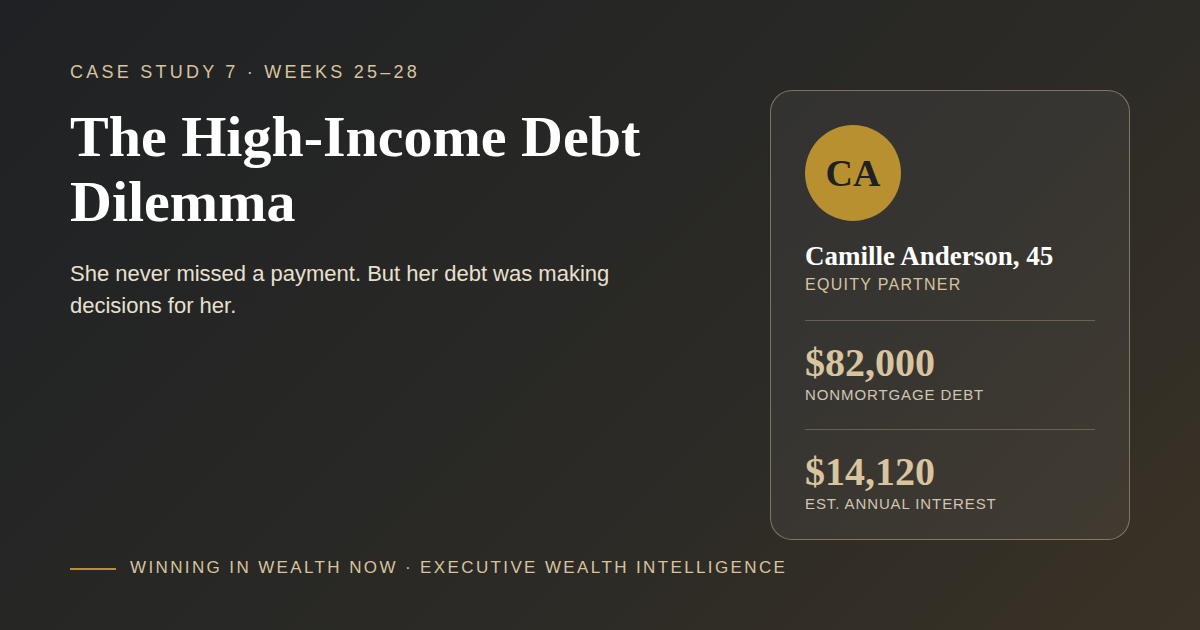
She Earned $295,000. But Her Debt Was Making Decisions for Her.
Camille earned $295,000 a year. She had never missed a payment. And she was carrying $82,000 in nonmortgage debt.
From the outside, nothing looked wrong.
She was a successful corporate attorney.
An equity partner.
A homeowner.
A mother raising two children.
A woman who had built an impressive career while navigating a divorce, professional transitions, and the responsibilities of supporting her family.
She paid her bills.
She contributed to retirement.
She had investment accounts.
And she wasn't struggling to make minimum payments.
But one evening, while reviewing her finances, Camille noticed something.
She could tell you how much she owed.
She could tell you what her monthly payments were.
But she couldn't tell you how much interest those balances were costing her every year.
Or how long it would take to eliminate them.
Or whether the money going toward interest could be used more effectively elsewhere.
And that's when she asked herself a question.
“Just because I can afford this debt, does that mean I should continue carrying it this way?”
That question had nothing to do with shame.
Camille's debt wasn't a reflection of her intelligence, her work ethic, or her character.
Some of it had accumulated during a difficult life transition.
Some had helped her maintain stability for her children.
Some came from decisions she'd made while balancing professional and personal responsibilities.
The issue wasn't whether those decisions had been justified.
The issue was whether her current debt structure still served her financial goals.
Because the ability to make a payment is not the same as the ability to afford its long-term cost.
Let's look at Camille's hypothetical debt:
| Debt | Balance | APR |
|---|---|---|
| Credit card | $32,000 | 24% |
| Credit card | $18,000 | 19% |
| Personal loan | $22,000 | 11% |
| Auto loan | $10,000 | 6% |
| Total | $82,000 |
At those starting balances and rates, the approximate annualized interest cost is $14,120 before accounting for balance reductions, compounding, or changes in rates.
That's not a forecast of the exact interest she'll pay this year.
But it is enough to get her attention.
Camille realized that debt wasn't simply a monthly payment.
It was an ongoing financial obligation competing with other priorities.
Retirement.
Liquidity.
Her children's education.
Future investments.
And the freedom to make decisions without relying on the next large paycheck.
Create a debt inventory.
For every balance, record:
The amount owed.
The annual percentage rate.
The minimum monthly payment.
Whether the rate is fixed or variable.
The estimated payoff date.
Then identify which balances have the highest borrowing costs.
Don't begin by judging yourself for the debt.
Begin by understanding it.
Camille receives a debt consolidation offer promising one payment and a lower interest rate. But when she examines the terms, she discovers that a smaller monthly payment doesn't necessarily mean a less expensive loan.
The Consolidation Offer That Lowered Her Payment but Increased Her Cost
Camille received an offer to consolidate her credit card debt into one loan.
The monthly payment looked better. But the total cost told a different story.
Last week, I introduced Camille.
A 45-year-old corporate attorney earning approximately $295,000 annually.
She was carrying $82,000 in nonmortgage debt.
She had never missed a payment.
And she wanted to understand whether her current debt strategy was helping or limiting her financial future.
So she began reviewing her options.
One offer caught her attention.
Consolidate her $50,000 in credit card balances into a personal loan.
Fixed interest rate.
One monthly payment.
A clear payoff date.
That sounded appealing.
Especially because Camille had a demanding career and wanted to simplify her finances.
But she knew enough to ask a second question.
“What will this loan actually cost me?”
Let's look at a simplified hypothetical comparison.
Suppose Camille is evaluating a $50,000 consolidation loan at 12% APR.
| $50,000 at 12% APR | 5 years | 7 years |
|---|---|---|
| Monthly payment | $1,112 | $883 |
| Total interest | ~$16,733 | ~$24,147 |
| Repayment period | 60 months | 84 months |
The seven-year loan reduces her required monthly payment by approximately $229.
But it also adds approximately $7,414 in total interest over the life of the loan.
Same amount borrowed.
Same interest rate.
Different repayment period.
Different total cost.
And that's before considering any origination fees.
Camille realized that a smaller payment wasn't necessarily a better financial outcome.
It might improve monthly cash flow.
And that could be valuable.
But if the lower payment came primarily from extending the loan, the long-term cost could increase.
She also needed to compare the consolidation offer against what would happen if she simply accelerated payments on her existing balances.
Because the right comparison wasn't:
“Is this new payment lower than what I'm paying now?”
It was:
“How does this option compare with the other realistic ways I could eliminate the debt?”
She also considered something important.
If she consolidated her credit cards and then accumulated new balances, she could end up with both the consolidation loan and new credit card debt.
That would undermine the purpose of the strategy.
Before consolidating debt, compare:
The new interest rate and APR.
The repayment term.
The required monthly payment.
The total interest and fees.
The total amount repaid.
Any prepayment penalties.
Whether the consolidation would create additional financial risks.
If you're comparing options, use the same payoff timeline wherever possible.
And remember that converting unsecured credit card debt into debt secured by your home introduces a different level of risk.
Camille understands the consolidation numbers. But now she faces another question: Should she put every extra dollar toward debt—or continue building savings and investments at the same time?
Should She Pay Off Every Dollar of Debt Before Investing?
Camille was told to stop investing until she paid off every dollar of debt.
But she wasn't convinced that one rule should govern every financial decision in her life.
By now, Camille understood the cost of her debt.
She knew which balances carried the highest interest rates.
She had compared consolidation offers.
And she understood that lowering a monthly payment didn't necessarily reduce the total cost.
But she still had a difficult question.
“Should I direct every available dollar toward debt—or continue saving and investing while I pay it down?”
It was a reasonable question.
Camille was 45.
She had retirement goals.
Two children.
A home.
A career that paid well but demanded a great deal of her time.
And she didn't want to spend years eliminating debt only to discover that she'd neglected other important financial priorities.
So she began evaluating the decision differently.
FIRST: THE COST OF THE DEBT
A credit card charging 24% APR is expensive.
Reducing that balance avoids future interest charges, which can provide a substantial and relatively predictable financial benefit.
An investment portfolio, by comparison, doesn't offer a guaranteed return.
And the investment would need to earn enough after taxes, fees, and risk to justify carrying that expensive debt.
That's a high hurdle.
SECOND: THE IMPORTANCE OF LIQUIDITY
Camille also understood that using every available dollar to pay down debt could leave her vulnerable to unexpected expenses.
If she exhausted her cash reserves and then faced a family emergency, she might have to borrow again.
So she needed to preserve an appropriate emergency reserve.
The amount depended on her household expenses, income stability, and responsibilities.
THIRD: RETIREMENT OPPORTUNITIES
Camille had access to a workplace retirement plan.
She wanted to understand whether reducing contributions would cause her to miss valuable employer contributions or other benefits.
That deserved a separate calculation.
FOURTH: THE INTEREST RATE ON EACH DEBT
Not all debt carries the same financial cost.
Camille's 24% credit card was a very different obligation from her 6% auto loan.
Treating them as identical simply because both were debts could lead to poor prioritization.
FIFTH: THE PURPOSE OF HER MONEY
Camille wanted to become debt-free.
But she also wanted accessible savings, retirement readiness, and greater financial independence.
Those goals needed to be coordinated.
Not forced into an artificial competition.
Here's the question that changed her approach.
“What is the most productive job for my next available dollar?”
Sometimes the answer may be eliminating expensive debt.
Sometimes it's preserving liquidity.
Sometimes it's capturing an employer retirement contribution.
And sometimes it's balancing multiple priorities.
The answer depends on the numbers and circumstances.
Camille didn't need a rigid slogan.
She needed a financial decision framework.
Divide your available cash into three priorities:
PROTECT: Maintain appropriate cash reserves and essential coverage.
REDUCE: Target expensive debt using a defined payoff strategy.
BUILD: Continue evaluating retirement and long-term wealth contributions.
Then ask which priority needs the most attention right now.
You don't have to abandon your future to address your past financial obligations.
But you do need to understand the cost of each decision.
Camille brings everything together. We'll walk through the debt strategy she builds, the numbers she decides to monitor, and the questions she asks before choosing a consolidation or accelerated payoff plan.
She Didn't Need Another Pay Raise. She Needed a Debt Strategy That Served Her Future.
Camille had spent years proving she could earn money.
Now she wanted to become more intentional about what happened to that money after it arrived.
Four weeks ago, we met Camille Anderson.
45 years old.
Equity partner at a corporate law firm.
Annual compensation of approximately $295,000.
A homeowner.
A mother of two.
And a woman carrying $82,000 in nonmortgage debt.
She wasn't behind on her payments.
She wasn't financially careless.
She had navigated significant life responsibilities while continuing to build a successful career.
But she wanted to understand whether her debt was quietly reducing her financial flexibility.
Over the last four weeks, Camille learned four things.
First, the amount of debt matters—but so does its interest cost.
Second, debt consolidation should be evaluated by total cost, not just the monthly payment.
Third, liquidity and retirement savings still deserve consideration while paying down debt.
And fourth, the right strategy depends on the actual financial circumstances.
So she built a debt action plan.
Not a punishment plan.
Not a promise to stop enjoying her life.
A financial strategy.
CAMILLE'S SEVEN-STEP DEBT ACTION PLAN
1. KNOW EVERY BALANCE
She listed each debt, interest rate, minimum payment, and remaining term. No guessing.
2. IDENTIFY THE MOST EXPENSIVE DEBT
She prioritized understanding the cost of her 24% and 19% credit cards. Those balances represented significant borrowing costs.
3. ESTABLISH A REALISTIC PAYOFF BUDGET
She reviewed her household cash flow to determine how much she could consistently direct toward debt reduction. Not just in an unusually good month. Every month.
4. COMPARE HER PAYOFF OPTIONS
She evaluated accelerated repayment, debt avalanche, debt snowball, and consolidation. She compared the costs, timelines, and behavioral considerations.
5. PROTECT HER LIQUIDITY
She determined how much accessible cash she needed to avoid relying on expensive credit during an unexpected event.
6. COORDINATE RETIREMENT AND WEALTH BUILDING
She reviewed her workplace retirement contributions, employer benefits, and long-term goals before changing her investment strategy.
7. REVIEW THE PLAN REGULARLY
She committed to reviewing balances, interest costs, cash reserves, and progress every month. Because a financial plan should adapt as circumstances change.
Then Camille asked one final question.
“What happens to the money I free up when this debt is gone?”
That question changed the meaning of debt freedom.
She didn't want to eliminate payments only to absorb the extra cash into lifestyle expenses without intention.
She wanted a plan for redirecting that future cash flow toward savings, investments, retirement, and other priorities.
For example, if a future debt payoff frees up $1,500 per month, that's $18,000 annually that could be reassigned.
It doesn't mean she automatically becomes $18,000 wealthier.
It means she has created a new opportunity to allocate cash intentionally.
And that opportunity deserves a plan before the money becomes available.
Create your own debt action plan.
Calculate your balances.
Identify your highest interest rates.
Compare realistic repayment options.
Protect appropriate liquidity.
Decide how debt repayment fits alongside retirement contributions.
And write down what you intend to do with the cash flow once each debt is eliminated.
The goal isn't simply to become debt-free.
It's to become financially stronger through the decisions you make along the way.
You can be a successful woman, carry debt, and still make a powerful financial shift.
Your past financial obligations do not have to define your future financial choices.
Camille's journey helped us examine how to manage existing financial obligations while continuing to build wealth. Next, we follow a senior executive who is changing employers and must decide what to do with a substantial retirement account: Questions to Ask Before Rolling Over a Retirement Account. Because changing jobs can create new opportunities. But moving retirement money deserves careful evaluation.
From affordable payments to intentional financial choices
“Being able to afford the payment doesn't tell me the full cost of my debt.”
“A lower consolidation payment may come with a higher total repayment cost.”
“Debt reduction, liquidity, and wealth building need to work together.”
“I can create a payoff plan that strengthens my financial future.”
Debt Consolidation Cost Calculator
Illustrative fixed-rate amortizing loan with monthly payments. Assumes the origination fee is paid separately and not financed. Excludes other charges and taxes. Actual lender terms vary.
See where you stand. Talk to a licensed professional.
Camille Anderson is a fictional composite created for education. All figures are hypothetical illustrations, not client results, quotes, or guarantees. Educational information only; not tax, legal, insurance, or investment advice. Product availability varies by state.