A couple can accumulate more than a million dollars and still be uncertain about retirement.
That's because retirement readiness isn't simply a question of net worth.
It's a question of whether available income and assets can support spending, taxes, healthcare, and the needs of both spouses over time.
Consider Michael and Angela Bennett, a fictional couple preparing to retire.
Michael is 64. Angela is 62.
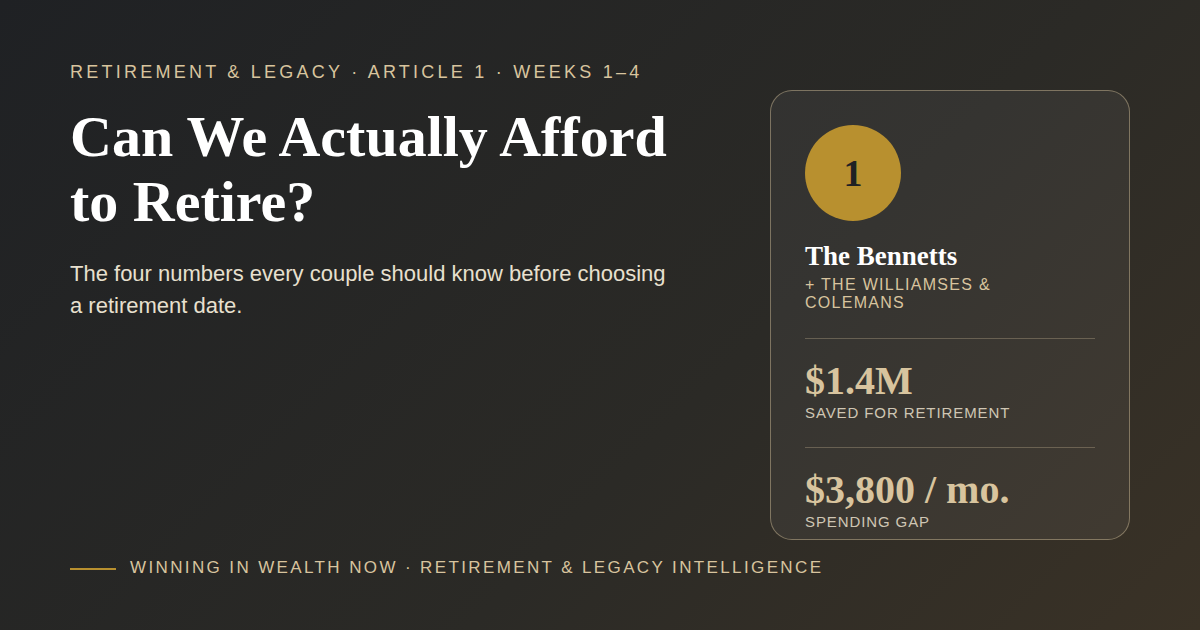
Together, they have $1.4 million in retirement and investment accounts.
Their expected Social Security benefits, if claimed at their selected ages, total $5,200 per month.
They want to spend $9,000 per month before accounting for any additional income taxes not already included in that budget.
At first glance, they appear well positioned.
But the couple hasn't separated essential spending from discretionary spending.
They haven't agreed on a withdrawal strategy.
And they haven't evaluated what happens when the first spouse dies.
Number One: Essential Monthly Expenses
The Bennetts calculate their essential expenses at $5,800 per month.
That includes housing, utilities, groceries, transportation, basic insurance, and recurring healthcare costs.
Annual essential spending is $5,800 × 12 = $69,600.
Number Two: Dependable Monthly Income
Their combined projected Social Security income is $5,200 per month, assuming the benefits begin at the ages used in their estimates.
That equals $62,400 annually.
Their essential-income gap is $69,600 − $62,400 = $7,200 annually. Or $600 per month.
They need to identify how to fund that gap.
Potential sources could include withdrawals, pension benefits, or an appropriately evaluated guaranteed-income arrangement.
But each option has different costs, risks, tax treatment, and survivor provisions.
Number Three: Total Spending Gap
The couple wants to spend $9,000 per month.
Their total spending target is $108,000 annually.
Subtracting their projected $62,400 of Social Security produces a preliminary annual spending gap of $45,600.
That's $3,800 per month.
It is a cash-flow planning figure, not necessarily the exact amount they must withdraw from investments.
Taxes, account types, healthcare expenses, and benefit timing can change the required gross withdrawals.
The couple needs a coordinated withdrawal analysis.
Number Four: Survivor Income
The Bennetts originally assumed that when one spouse dies, the surviving spouse would continue receiving both Social Security checks.
That is generally not how Social Security survivor benefits work.
The survivor may qualify for a benefit based on the deceased spouse's record, but the two full retirement benefits generally do not continue together.
The survivor's actual benefit depends on the relevant Social Security rules and individual circumstances.
Meanwhile, many household expenses remain.
Housing costs may change little.
Insurance and healthcare expenses may change.
Tax filing status may change.
And pension benefits, if any, depend on the selected survivor option.
A retirement plan built for two people must also be evaluated for the one person who may eventually remain.
A Better Retirement Decision Framework
Before choosing a retirement date, a couple should calculate:
Essential monthly spending.
Desired total spending.
Dependable income and when it begins.
The amount and tax character of required withdrawals.
Healthcare and unexpected expense reserves.
Income and spending after the first spouse dies.
The next step is to test the plan against inflation, poor investment returns, longevity, and changes in family circumstances.
Know your numbers. Coordinate your income. Protect the survivor.